
Product Discovery Depends on the Stage of Your Startup
One of the most common questions founders and product teams ask is:
How do we determine what product to build?
The answer lies in a process known as product discovery. Product discovery is the structured effort to understand customer problems, identify opportunities, and determine what products or features will deliver value to both customers and the business.
However, product discovery is often discussed as if it were a universal process that works the same way for every company. In reality, that assumption can be misleading.
Before planning product discovery activities, founders and product builders must first determine what their needs are at the current stage of their company. The type of questions you need answered, the data available to you, and the goals of your product efforts all evolve as your startup grows.
Today there is a large amount of literature, frameworks, and advice around product discovery. While many of these resources are valuable, they can also become distracting and sometimes irrelevant if applied without considering the stage of the startup. Early-stage founders, for example, may read about advanced product analytics or large-scale experimentation frameworks that are simply not applicable to their situation.
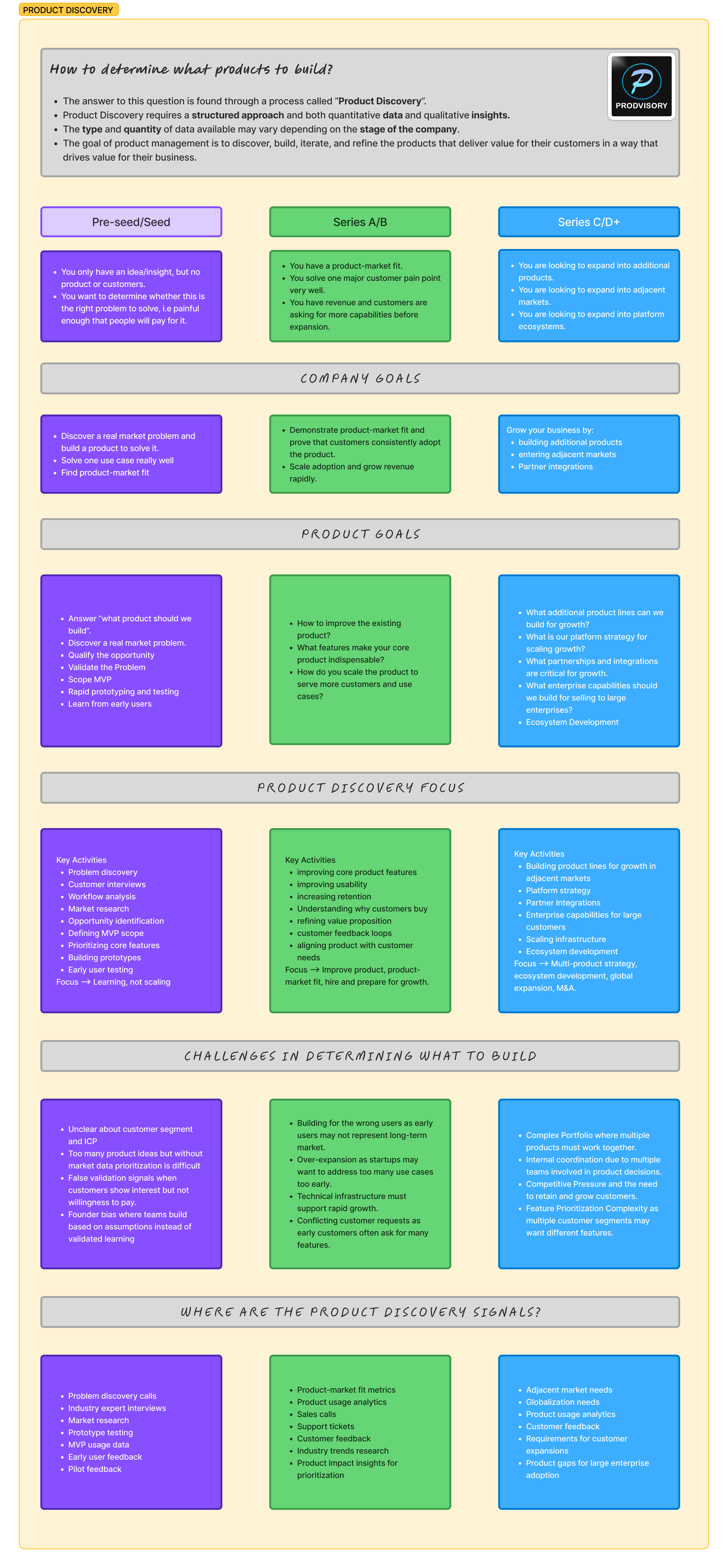
Understanding the stage of your company is critical because the type and quantity of data and signals available to you will be very different at each stage. A pre-seed startup may rely heavily on customer interviews and early experiments, while later-stage companies have access to product analytics, sales data, support signals, and broader market insights.
Similarly, your product goals evolve as the company grows. Early on, discovery is focused on identifying a real problem and defining an MVP. As the startup matures, discovery shifts toward improving the product, scaling adoption, and eventually expanding into new markets and product lines.
For this reason, product discovery should not be treated as a generic checklist. It must be aligned with the stage of the company and the specific decisions the team needs to make.
To help founders and product teams stay focused, I created the infographic below to illustrate how product discovery typically changes across different stages of a startup. The goal is simple: provide clarity so that teams can concentrate on the discovery work that matters most for their stage, without getting lost in an overwhelming amount of generic advice.
Before diving into product discovery frameworks, ask yourself a simple question:
Do you know what you need to learn from product discovery at the stage your startup is in today?
If you're thinking about how to approach product discovery more effectively—or trying to determine what product to build next—feel free to book a consultation with Prodvisory. Sometimes a short conversation can bring clarity to the most important product decisions ahead.